The curriculum

Written for licensure, designed for human bodies.

A full program organized so a thoughtful person can actually finish it — and carry it into thirty years of working in a shop.

Table of modules

The six modules

  1. I. Anatomy & physiology for hairdressers 01 A complete working map of the head and neck. The hardest mistakes are anatomy mistakes.
  2. II. Hair & scalp science 02 Hair is dead protein. Prevention is the only real tool. Porosity gets its own lesson.
  3. III. Infection control & blood-borne pathogens 03 Clinical practice, taught as clinical practice. Cold enough to run without conscious thought.
  4. IV. Stylist health & safety 04 Five career-ending injuries. Predictable. Preventable.
  5. V. Salon management & hygiene 05 A small business and a clinical environment. Both halves, with the same seriousness.
  6. VI. Osteopathic awareness 06 The module that does not exist anywhere else. The body as the most important tool in the kit.

01Module

Foundations · the working map

Anatomy & physiology for hairdressers.

A stylist puts their hands on a living human body every day. They press on skulls, pull on muscles, work close to arteries, and apply chemicals to skin only a few millimeters thick.

Most cosmetology programs spend a few hours on anatomy and move on. The Collective treats it as foundational. The hardest mistakes are anatomy mistakes — a shampoo bowl pressed into the wrong spot on the neck, a chemical service on a scalp with the wrong condition, a lump dismissed because no one knew what was under the ear.

The module builds a complete working map of the head and neck. Cranial and facial bones, the muscles of mastication and expression, the five layers of the scalp itself, the trigeminal nerve, the blood supply, the lymphatic drainage. From there: cells and tissues, the major body systems a stylist needs to recognize, and the conditions that change how a scalp responds to a service.

  • Beauty parlor stroke syndrome and safe shampoo-bowl positioning.
  • The five scalp layers and what each one does during a massage.
  • Lymph node locations — behind the ear, along the jaw, down the neck.
  • The trigeminal nerve, tension headaches from updos, and how to ease them.
  • Skin layers, sebaceous and sweat glands, and chemical interactions.

Fig. 1 · Cranial map
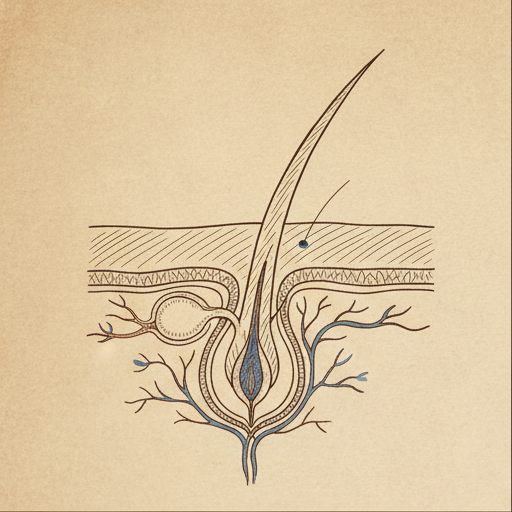
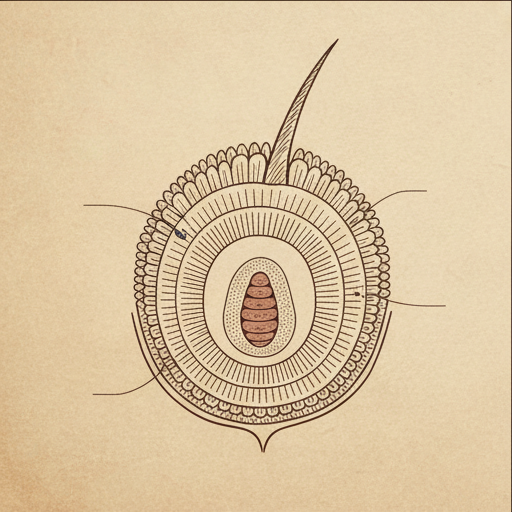
A textbook-style anatomical illustration of a hair follicle in cross-section.
Follicle, in section 01
  • Hair shaft
  • Sebaceous gland
  • Follicle
  • Dermal papilla
  • Blood supply
  • Hair bulb

02Module

The strand · the follicle · the scalp

Hair & scalp science.

Hair is dead protein. The only living part is the follicle, buried under the scalp. Every strand a stylist cuts has already left the body.

That fact changes how the trade should be practiced — and it is the fact most stylists were never taught to take seriously. You cannot heal hair. You can only protect it, temporarily patch it, or cut the damage off. Prevention is the only real tool.

The module begins with structure. The three layers of the shaft — cuticle, cortex, medulla — and what each one does during a service. The bonds that hold the cortex together: disulfide, hydrogen, salt. Melanin, eumelanin and pheomelanin, and how underlying pigment shows up the moment a lightener starts to lift.

The scalp half is just as substantial. The follicle as a living organ, its growth cycle, the scalp microbiome, common scalp conditions, and the precise rule for when a stylist refers out and stops the service.

  • The cuticle as a gatekeeper — porosity, raised vs. closed.
  • Disulfide bonds and the chemistry of perms, relaxers, and bond-builders.
  • Underlying pigment and the lift levels.
  • The hair growth cycle and what shedding patterns actually mean.
  • Scalp conditions and the referral protocol.

Fig. 2 · Hair shaft

A vintage textbook cross-section of a hair shaft.
Cuticle, cortex, medulla 02
  • Cuticle
  • Cortex
  • Medulla

03Module

Pathogens · protocols · the clinical hour

Infection control & blood-borne pathogens.

This is the part of the curriculum every state board tests heavily, and most schools teach as a slide deck of definitions. The Collective treats it as clinical practice, because that is what it is.

A comb that looks clean can carry thousands of organisms. A pair of shears that nicked a scalp last week can carry hepatitis for days. The visual eye is unreliable at the scale that matters, and a stylist’s job is to know the protocols cold enough that they run without conscious thought.

The module covers the four pathogen categories — bacteria, viruses, fungi, parasites — with the specific organisms that show up in salon work. For each: what it looks like, how it spreads, what to do the moment it appears in the chair. The decontamination hierarchy. The OSHA-aligned blood-borne pathogen standard. The full exposure incident protocol.

  • The four pathogen categories with the salon-relevant organisms in each.
  • Clean first, then disinfect; sterilize only when warranted.
  • OSHA blood-borne pathogen standard, written for a working salon.
  • Exposure incident protocol: the first ten minutes, the first 24 hours.
  • Hand hygiene and the disinfectants that actually meet the label claims.

Fig. 3 · The dispensary

Vintage apothecary jars on a studio dispensary shelf.
Apothecary, working order 03

04Module

A thirty-year body · a working knowledge

Stylist health & safety.

The career-ending injuries of this trade are predictable. The average stylist career ends in seven to ten years — not because the talent ran out, but because the body did.

Carpal tunnel from the shear grip. Cervical disc damage from looking down for thousands of hours. Rotator-cuff tears from blow-drying overhead. De Quervain’s tenosynovitis from the thumb-over-comb. Chronic low back pain from standing eight hours a day in the wrong shoes.

The module covers ergonomics in working terms, ventilation and chemical exposure, hearing protection, voice care, eyes, feet, pregnancy safety, hydration and meals. Not wellness in the marketing sense — the working knowledge of how a body lasts thirty years on its feet.

  • The five career-ending injuries and the specific motions that cause each.
  • Chair height, station setup, and the cervical spine.
  • Ventilation, mask use, and the chemical exposure profile of long-career colorists.
  • Pregnancy safety: which services, which products, which trimesters.
  • The early warning signs of repetitive-strain injury and the recovery protocols that work.

Fig. 4 · Hands at work

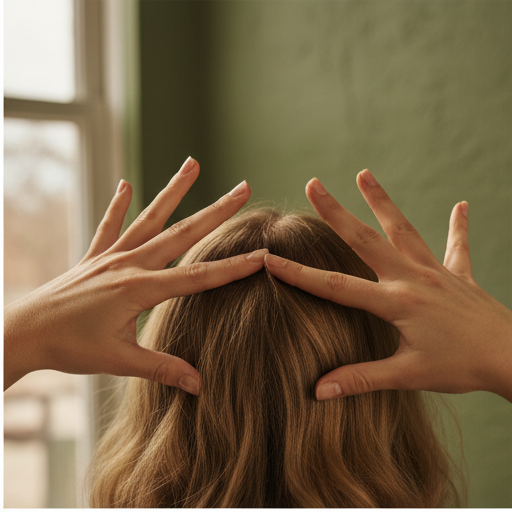
A close-up of a stylist's hands parting hair at the working chair.
The working hand 04

05Module

The shop · the business · the standards

Salon management & hygiene.

A salon is a small business and a clinical environment at the same time. The module covers both halves with the same seriousness.

A client decides whether to trust a stylist in roughly ten seconds, mostly on smell and visual cleanliness, before a word is spoken. A station that looks like it could pass a board inspection right now is not a chore; it is the marketing.

On the business side: scheduling and the math of utilization, pricing that pays for the time the service actually takes, the choice between commission, booth rental, and W-2 employment with benefits. On the hygiene side: the daily protocols that turn a salon into a place clients trust over decades. The module also takes client communication seriously as a clinical skill.

  • The ten-second walk-in scan: smell, floor, station, light, sound.
  • Pricing for the actual time of a service, not the advertised time.
  • Commission vs. booth rental vs. W-2: who pays for what, who keeps what.
  • The consultation as a structured intake, with consent and patch-test records.
  • Daily, weekly, and monthly hygiene protocols that hold up to a real inspection.

Fig. 5 · The station

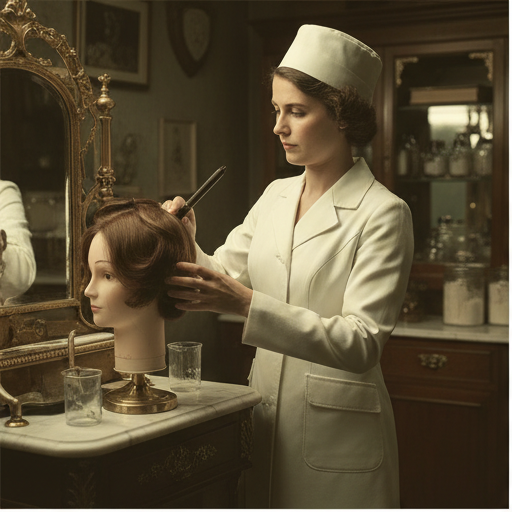
A mentor's working station: clean, ordered, ready for the day.
Station, in working order 05

06Module

The body as the most important tool in the kit

Osteopathic awareness.

This is the module that does not exist anywhere else, and it is at the heart of what makes the Collective’s curriculum different. Hair grows from a body. Stylists work on the head, neck, and upper spine for hours at a time, and stand on their own feet for the rest of it. Both bodies in the room deserve consideration.

The module starts with the scalp as an engineered system: the five layers an acronym (S-C-A-L-P) describes. The loose areolar layer that lets a scalp massage actually slide. The galea aponeurotica that goes tight when a client has been clenching their jaw for a week. From there: fascial chains, the cervical spine under a wash bowl, shoulder mechanics for blow-drying, hand health for the shear grip.

The second half is self-care as a clinical subject. Posture. Microbreaks. The specific stretches that reverse the day’s motions before they become permanent. The recovery practices that work.

  • The five scalp layers as a working system.
  • Fascial chains: scalp tension into the shoulders, the jaw, the low back.
  • The cervical spine under a wash bowl: what is safe, what is not.
  • The shear grip and the thumb tendon: the early signs of De Quervain’s.
  • Microbreaks, eye breaks, and the recovery stretches that reverse a working day.

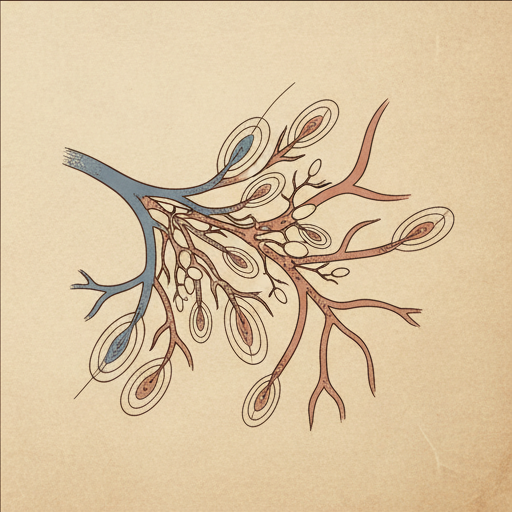
Fig. 6 · The blood supply

A textbook diagram of scalp microcirculation.
Scalp microcirculation 06
  • Arteriole
  • Capillary bed
  • Venule

Specimen

Licensure-hour categories

The curriculum is built to map cleanly onto the hour categories most cosmetology licensure boards track. The modules are tagged so each lesson lands in the correct column, and an apprentice can see where their hours are accumulating.

i.

Theory

Foundations

ii.

Cutting

Shape & line

iii.

Color

Permanent · demi · lightener

iv.

Chemical

Texture services

v.

Styling

Finish & form

vi.

Extensions

Methods & aftercare

vii.

Business

Salon practice

viii.

Health & safety

Stylist & client

The apprenticeship-route structure travels to any jurisdiction that wants it. The hour columns reshape; the curriculum does not.

A working note

How the modules are made

Each module is short by design. A reading, a demonstration, and a working assessment that happens in the salon, not on paper. There are no surprise quizzes. Practice is not gated behind a clock. The standard is high; the path to it is humane.

Modules are versioned. When the science updates — new research on the scalp microbiome, a revised blood-borne-pathogen guideline — the module updates, and every practitioner in the Collective sees the change.

Read about the methodology →

Rooted in the past.
Focused on the future.
Growing together.